Thursday, September 13, 2012

Night 3--Spoiler Alert.....still no spawn!


Team Burr_Diodon
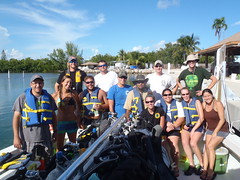
Coral Spawning volunteers on the KML R/V Diadon

Despite lovely weather, great marine themed humor (Thanks to Shelby), good company and mood music provided by Sir Elton John, we did not in fact “Feel the love tonight.” There were reports from many other places in the Caribbean of Montastrea species spawning including the Upper Keys, Mexico, Belize and the U.S. Virgin Islands. Some worry was beginning to creep into our minds and hearts that the Middle Keys was not going to reproduce this year.....

Genome colony_33-4
Waving the lucky coral spawning wand over a Montastrea colony
 While we don’t understand exactly why reefs vary in this way, in previous years we have observed that some areas within the Keys will spawn and others won’t. We will keep an optimistic outlook however, get a good night’s sleep and head back to the reef tomorrow for our final planned collecting trip. With this type of research, there are some things that are just out of our control, thus we wait……..


Thursday, September 6, 2012

Night 2 on the Reefs


Night 2 on the Florida Reefs!

Boat roster; two boat teams going out; one from KML the other from Mote Marine Lab
A slow morning for those at KML as we tried to get some rest after the long night, and in preparation for the next few nights with spawning and larval caring.
Peter, Charlotte and Chris help repair tents


But by afternoon, we had boat kits packed, tents repaired, sea water filtered, glow-sticks ready to go, flashlights checked, and new arriving volunteers orientated.


Mote Marine Laboratory, Summerland Key


For the next several nights Team BURR will be going out on two boats; the R/V Diadon from KML and the Moat Boat from Mote Marine Laboratory in Summerland Key.  The Diadon will be going to Alligator Reef every night and the Mote Boat goes out to Looe Key every night.


Mote Boat preparing for departure for Looe Key


 Joining Team BURR (Anke, Shelby, Rachel, Charlotte and Sacha) aboard the Mote Boat from Mote Marine Lab was Corey (our captain), Kim, and Chris. The remainder of our army of volunteers and BURR members were at Alligator Reef.

Anke and Charlotte aboard the Mote Boat


Anke and Charlotte enjoy a lovely boat cruise out to Looe Key!


Kim and Shelby set up tents


All teams were a-go as tent set-up occurred at both Alligator Reef and Looe Key.


Chris tenting M. fav


Chris, tenting a beautiful colony of Montastrea faveolata

Nicely done setting up!
 Looe Key is a beautiful reef, so our divers and snorkelers were lucky to have some time after setting up to explore the reef a bit before heading back to the boat for the long wait.

Looe Key is a beautiful diving or snorkeling site!


Montastrea faveolata.....


........spawning!!
This is what we want to see!
Shelby all geared up to check for spawning


We checked between 10:30pm until about 11:20pm but none of the corals were setting or showing any signs of spawning.

No spawning corals, but a bunch of barracuda and even a shark were spotted at Looe Key


Back to KML by 2:30pm, Team BURR and all volunteers cleaned up gear and tents and headed to the dorms or bay house for some much-needed rest....who is going to dream of coral spawning for Night 3 on the Reef?!

Wednesday, September 5, 2012

Dry Run (Night 1)

 Dry Run Night!

DJ on the high seas

 Tuesday morning was a water run for 9 garbage bins of sea water to be filtered. Rachel loves the boat days, and DJ agreed to come along for his maiden voyage on one of KML's vessels. The water was beautiful and Cindy, Rachel and DJ had high hopes for the calm seas to stay until the evening hours. In fact, DJ even hoped for calmer waters for tonight to ease any sea sickness.

Rachel getting sea water. Photo courtesy of Cindy!
Beware of that leaky garbage bin!


Mac giving the volunteers a run-down of the next few nights

By 1pm most of the spawning volunteers had arrived and were listening to an orientation by Mac and Shelby. A great group of divers and snorkelers, BURR is shaping up to look like a fantastic team!
Shelby showing off the wet lab and explaining the kreisels


After the classroom session and a fantastic powerpoint presentation by none other than our own Shelby, everyone became familiar with the set-up out in the wet lab as well as the basics on filtering sea water (a very important non-stop task over the next few days)


Captain Bill overseeing his crew


And we're off! By 5pm all gear; scuba equipment, boat kits, tents, flashlights, and snacks were loaded on the R/V Diadon with Bill and Trevor captaining the ship.


Mac giving instructions for the teams


Mac gave the team instructions for setting up tents at the spawning site, Alligator Reef. 3 teams set up 6 tents each on different colonies of Montastrea faveolata. Team 2 and 3 were the teams specifically collecting egg-sperm bundles for DJ and Bishoy's projects.
Charlotte and Shelby ready to tent some corals

Good thing for Dry Runs, we got everything set up with only a little bit of troubles, but made it back on the boat for a beautiful sunset as we started the long wait for corals to set and spawn.


By 10:30pm Mac and Pam were in the water, checking to see if the corals set, while the rest of the team waited on board for them to surface with news of setting....They were down until after 11:15pm, and unfortunately did not see any of the colonies ready to spawn. Teams got back together in the water to retrieve the tents and cyalumes. No corals spawned, but it was a good dry run and I think the entire Team feels much more prepared for Night 2 of spawning. The night was did have a few perks; a Hawksbill turtle was spotted by Mac and Pam, and a flashlight accidentally dropped by Pam was actually found by Peter on the tent collection dive!
Peace and sunsets
 Way to go everyone! Now, go get some rest, and be ready to get out to the wet lab and start filtering sea water, prep the cyalumes, and get gear ready for Night 2!

Tuesday, September 4, 2012

Labor Day Weekend

A long weekend getting ready for the even longer 4 days ahead!
Just because Rachel loves Cassiopea xamachana
 While the rest of the FL Keys enjoyed their long holiday Labor Day weekend, Team BURR at KML labored hard as the arrival of Mac, Pam and DJ spurred new energy and enthusiasm!


Pam, already hard at work prepping the glow sticks


Pam, a veteran coral spawning volunteer and most reliable team member got right to work helping out with anything and everything from organizing the mess of the refrigerator to prepping the cyalumes (glow sticks) and filtering sea water. It is such a relief to have her and her positive energy with us once again!


DJ happy as always to be working


DJ has been busy getting all his supplies ready for his project. He will be collecting egg-sperm bundles at Alligator reef for his MS project to see if corals with horizontal transmission of symbionts also partake in vertical transmission. More specifically, if Montastrea faveolata egg-sperm bundles harbor symbionts, and to what extent are they genetically similar to the maternal colony.


Shelby is excited for the arrival of the volunteers


After a long day of preparing the wet lab, filtering sea water, and generally organizing and getting everything all set, the wet lab looks coral spawning official! Kreisels are up and running leak-free with sea water, each kreisel labeled with what it will be inoculated with (Clade B, Clade A, Mixed (A and B), and Natural.), the boat kits stocked, flashlights checked, tents all prepared, and coolers set up on cinder blocks ready for the larvae.

Kreisels in full operation


 Now all we need is for those corals to spawn!


BURR LAB IS READY! 


Sunday evening Mac, Anke, Shelby, Rachel, DJ, Pam and Cindy all took a trip up to Key Largo to visit with Bill Fitt and Susan Quinlan, Jim Porter, Dusty Kemp and Ashton (University of Georgia, Athens), Steve and Rita Kempf (Auburn University), and Joe Schubaurer (EPA). We enjoyed a wonderful evening away from KML with good food, snorkeling and company! As well as conversation that was both scientific and just for fun! It was a great time meeting with fellow Symbiodinium,coral, and jellyfish scientists!
The crew of scientists gathering together! Missing from the picture: Jim, Joe, and Ashton


DJ the beautiful mermaid and Rachel the Keys Fisheries chef

Monday, September 3, 2012

The Preparations Continue!

Preparations continue for the spawning of Montastrea faveolata at the Keys Marine Laboratory!


With the dates of spawning corals rapidly approaching, Team BURR has been hard at work preparing KML for coral larvae as well as a herd of eager volunteers.


While Anke and Rachel kept busy around KML, Shelby made a trip back to Buffalo to do 96 extractions and 170 PCRs in about 48 hours time....then hopped back on a flight right back to help with spawning prep.....with energy! Way to go Shelby!


Rachel loves power tools

Hurricane Issac created a bit of a set-back for our preparations, but luckily Anke, Shelby and Rachel were able to get just quite a lot of work done in time for Mac, Pam and DJ's arrival on Saturday evening.

Preparations included drilling holes in kreisels (much to Rachel's delight), labeling 180 tiles, filtering gallons of sea water, and cleaning up from the Thermal Tolerance Experiment, making multiple trips to Home Depot for supplies, and setting up/washing supplies down....just to name a few of the tasks around KML.


Chris Page to the rescue! also to note, the army of labeled tiles
Traveling up from Mote Marine Lab Wednesday evening was Chris Page, former student of Howard Lasker's (at the University of Buffalo), and a seasoned veteran of coral spawning as well as kreisel building. Without Noel and his ability to set up kreisels in record speed (some might even argue1-2 days is all he needs, but this is debatable), Anke and Rachel bargained with Chris to help start the kreisel set-up in return for "Fancy Dinner Wednesday" ala Anke. His help was greatly appreciated, and despite being eaten alive by sand flies out in the wet lab until 9pm, 3 kreisels were set up and his knowledge and expertise was passed down to Anke and Rachel to teach future generations of kreisel-builders.
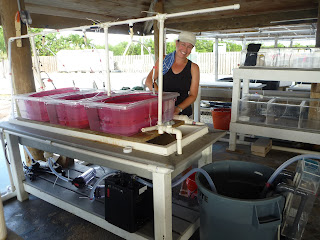
Anke, happily setting up kreisels

Ahoy Anke!


Friday morning was a scheduled boat trip on the Diadon with the one and only Cindy Lewis (much to both Anke and Rachel's delight!). 


The first stop was Tennessee Reef, where Anke and Cindy tagged some lovely colonies of Montastrea faveolata for Bishoy (student from Monica Medina's lab) to collect sperm to get DNA without zooxanthellae. Cindy and Anke also ran some transects to mark the colonies as well. A successful dive well done, or as Anke says, "It was ace!"


Rachel and Cindy all set to dive


Tennessee Reef Spa was the second stop on the boat day, where Cindy and Anke joined Rachel for her first dive in the big blue ocean.


Definitely different than quarry dives back up in Buffalo!
Excited to find an Acropora palmata colony


Anke was a wonderful photographer and captured the events of the dive, including the finding of a beautiful colony of Acropora palmata!


Last stop of the day was collecting 4 garbage bins of sea water for which always promises to be  many hours of filtering later......(much to everyone's delight)

Anke and Shelby working hard with the kreisel set-up!


With Shelby's arrival on Friday night, the 3 worked together to successfully set up one kreisel running with thrice filtered sea water, and 2 others running with fresh water.


Shelby is a master at fixing leaks


The transformation of the wet lab into a coral larvae nursery is finally starting to look official. With spirits high, the evening was celebrated by a trip to the world-famous "Keys Fisheries" for dinner. With all the hard work, it was a much-needed treat!

Days in-counting to spawning corals, the arrival of Mac, Pam, DJ, and all the coral enthusiasts.....with sunsets such as these here at KML, can you think of anywhere else better to be than the beautiful FL Keys?!

Sunset at the Keys Marine Lab

Sunday, September 2, 2012

An introduction by Shelby


Welcome back to the BURR lab’s Blog on Coral Spawning 2012!

We are excited to be embarking on a new season with new and old students and  projects.

Rachel celebrating the completion of her thesis on the upside-down jellyfish, Cassiopea
First off, congratulations to Rachel, who earned her Master’s degree from her work on the upside-down jellyfish, Cassiopea spp. Her fruitful research last year has revealed some interesting patterns in the way that these jellyfish take up and maintain their algal symbionts. In addition to being back in the field this year to help us with our coral spawning work, Rachel is also writing up her research for publication, which is the primary way scientists communicate their findings.

Noel, who investigated the genetic link between symbionts of adult and newly settled corals, is in the final stages of sample processing and will be graduating this fall. Impressively, he has taken up a full time job as a laboratory technician while finishing his thesis. This means that he could not join us in the field this summer and his hard work and good attitude are missed!


Daniel Joseph (DJ) is a new member of the BURR lab and is commencing his Master’s degree this year. His project will investigate the potential for adult corals to pass their algal symbiont to the egg and sperm bundles in coral species that are generally known to take up symbionts from the environment between generations. He will be using molecular techniques as well as good old-fashioned microscopy to test his hypotheses.


Shelby is in it for the long haul and is working her way through her Ph.D. research. The success from last year’s spawning has provided a plethora of interesting data on how the physiology of the reef-building coral Montastrea faveolata changes depending on the symbiotic algal type it is associated with. The summer started with testing the sensitivity to high temperatures of one-year-old larvae that we settled last summer and maintained for a whole year. These results will help us to understand and predict how corals will fare in our warming oceans. This summer, she will be expanding these questions by exposing coral larvae with mixes of symbionts to see how these more complex systems function.

Anke is working as a Research Scientist in our lab and has been heading our microarray analyses. She has been working with the Medina lab at the University of California Merced to analyze functional gene expression of M. faveolata after it has formed a symbiosis with different types of algal symbionts. The symbiosis has been monitored over 6 months. This year, additional experiments are planned to investigate the effect of a greater variety of symbiont types as well as a combination of types. Anke will also follow up on questions that may help us to better understand why some symbionts can be taken up by the coral and some cannot.


JULY and AUGUST 2012


The summer has begun with plenty of excitement. Our corals settled in 2011 have been well maintained at the University of Miami over the past year. They were kept with only the symbionts we exposed them to in our experiments last year. This included corals with either Clade A, Clade B or no symbionts. We picked up our coral babies on our way to the Keys Marine Lab. These one-year-old polyps were part of an experiment to measure how corals with either Clade A or Clade B symbionts responded to increased water temperatures. This is an important measure since “bleaching” temperatures are occurring more frequently in our tropical oceans.
We used an instrument called a PAM fluorometer to detect any damage to the algae caused by the increased temperatures. We had to take these measurements before sunrise, which meant that for 10 days, Anke and Shelby were up and in the lab by 5:00AM. In the end, our hard work resulted in some nice data that will help us understand the tradeoffs for a coral hosting particular types of algae.

For the last few days of this experiment we had to keep one eye on the weather forecast as the Keys were being threatened by Hurricane Isaac, which was making its way through the Caribbean. Instead of beginning our lab set-up for the upcoming spawning season, we were tying down everything that could fly and preparing for up to 70 mph winds. With spawning less than two weeks away, we nervously awaited our fate. In the end, we evacuated the Keys for a few nights while the storm passed and we will be working overtime to make up for lost time. At this point we all have our fingers crossed that the worst has passed and we will have sunny skies in the weeks ahead.
A view of the beach during tropical storm Issac

Volunteer MJ, working hard to help us to prepare for coral spawning